

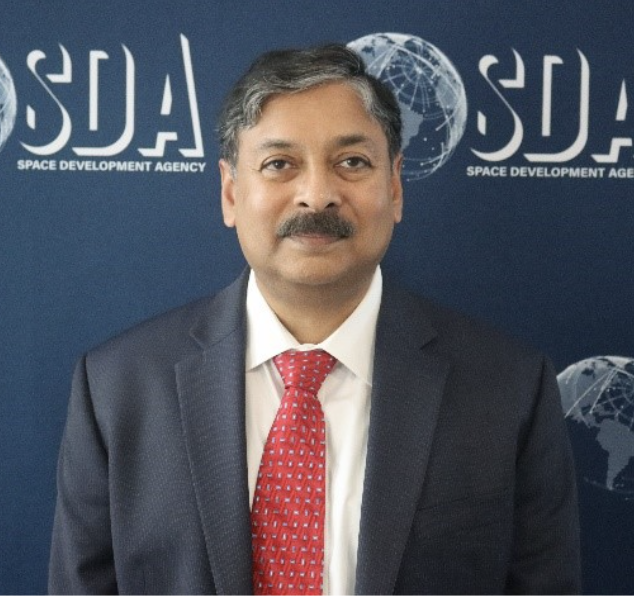
Dr. Sanjay Parthasarathy spent much of his career helping aerospace and defense companies navigate technological change, develop new capabilities and bring products to market faster. His experience spans technical and executive leadership at Honeywell Aerospace, Cobham Advanced Electronic Solutions and LMI, as well as strategy and business development roles at Raytheon and Leidos.
That industry perspective now informs his work at the Space Development Agency, where he serves as chief capability officer.
For Parthasarathy, moving from industry into public service was driven by a desire to help government move faster. As part of SDA’s effort to rapidly develop and field space-based capabilities for the joint warfighter, he helps identify capability gaps, shape investment road maps, engage industry and manage the risks involved in bringing new technologies from requirements to deployment.
In this Q&A, Parthasarathy discusses what drew him from industry to government, why he believes the key to faster acquisition is motivating talented public servants around a consequential mission, and what he hopes his time in public service will contribute to the future of defense technology and the next generation of leaders.
Tell us about your current role and the mission you support. What does a typical day look like for you?
As the Chief Capability Officer for the Space Development Agency, I support the missile warning, tracking and defeat mission to defend U.S. interests against ballistic, hypersonic, and advanced missile threats.
A third of a typical day is devoted to ensuring the disciplined execution of the SDA’s tranche programs. Another third is spent in proactively identifying capability gaps, prioritizing investments and executing roadmaps for future tranches. The remaining time is spent helping communicate SDA impacts with Congressional and agency stakeholders, eliminating roadblocks to speedy decision-making, and managing military, civilian, contractor and academic staff.
What drew you to public service? Was your path into government planned, or did it evolve over time?
I was drawn to public service by the ability to have a meaningful and sustained impact on technology-enabled defense procurements. While working in the aerospace and defense industry, I had seen a wide variance in speed, agility and commercially leveraged procurements by government decision-makers. I believe my experience and results-driven approach can make our adoption and operationalization of defense technologies much faster.
I wanted to contribute to the rapid adoption of commercial technologies in the defense industry. Being in Washington, D.C., I wanted to learn how and why decisions are made inside the government, and contribute to making those decisions better by leveraging the best of industry and commercial organizations.
What does public service mean to you, and why is serving the nation and its citizens important to you?
Public service is the tide that lifts all boats. It is the lynchpin for societal improvement. Our nation and its people have given me a lot to be thankful for. Embracing public service is a way of giving back, and doing so with the experience I have amassed will hopefully have a lasting impact on the defense industry and inspire the next generation of leaders.
What is one lesson you’ve learned in public service that has stayed with you throughout your career?
There is no dearth of smart, hard-working staff in the government. The key is how we motivate them to deliver the best version of themselves every day aligned to a mission that is consequential to the nation and meaningful to them.
What advice would you give to someone considering a career in government today?
Give back to your country and community at least for a couple of years. You will be a better leader knowing how the government works, and your future contributions will be more aligned to what our nation needs. And you will appreciate the smart and tenacious public servants who are the invisible force that deliver to your needs and to your safety.