

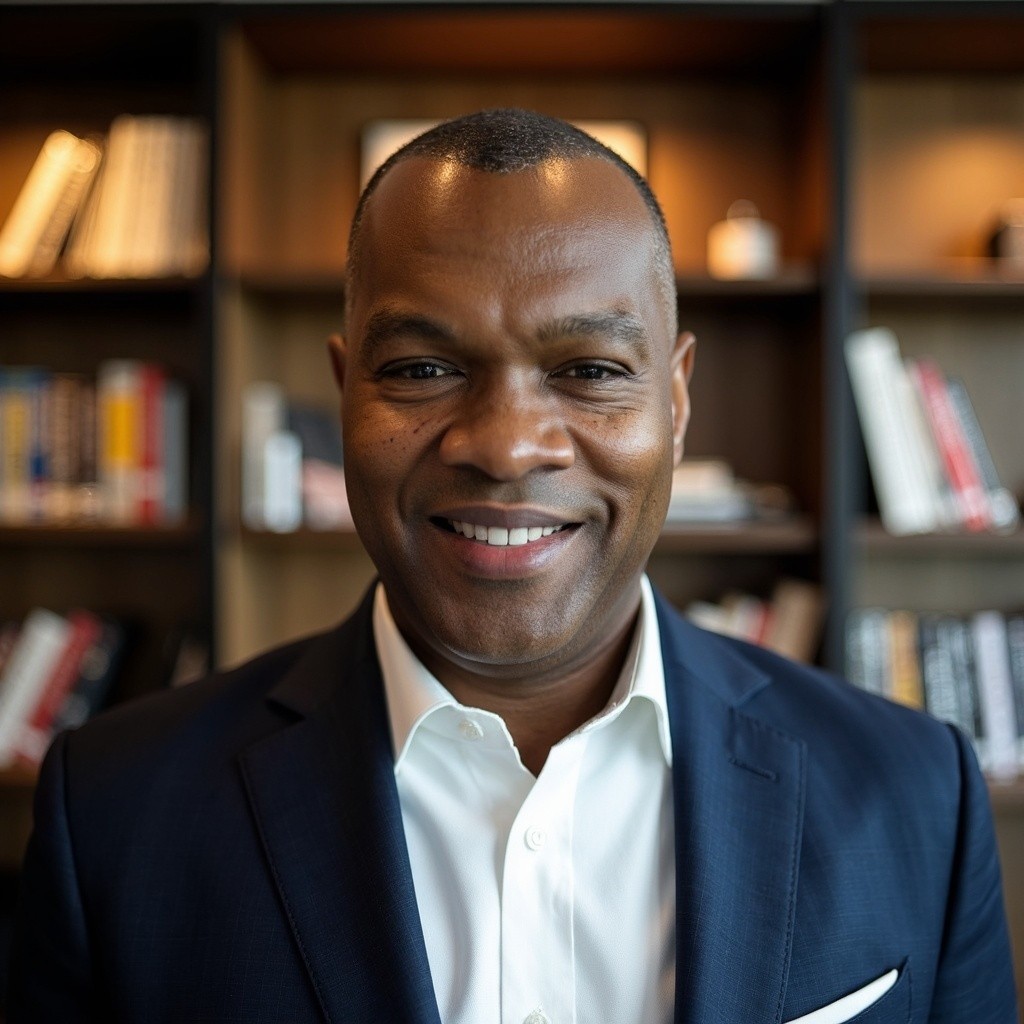
In college, Horace Blackman disc jockeyed at a small radio station. Learning about music, speaking and how to operate the equipment was only the beginning.
“I got really in tune with understanding what people wanted and how to deliver a product to folks with very little feedback,” said Blackman, president of NTT DATA Federal since April. “In our business, it reminds me of being a radio deejay where you’re talking into a microphone and playing music without a lot of feedback.”
Those lessons stayed with him throughout a career spanning more than three decades. A Federal Computer Week Federal 100 Award recipient and three-time FedHealthIT100 honoree, Blackman has built his career at the intersection of technology, business and mission delivery.
Today, he brings that experience to NTT DATA Federal, which serves more than 90 federal agencies through digital transformation, technology and consulting services. As government agencies navigate the rapid evolution of AI and other emerging technologies, Blackman helps clients adapt, innovate and operate more efficiently.
Moving, McDonald’s and Mission
Growing up in a military family, Blackman grew accustomed to being the new kid in a new school, over and over and over. Frequent moves taught him how to quickly assess new environments, build relationships and adapt to change. He still relies on these skills today as president of NTT DATA Federal.
“You have to be a quick study of the organization, you have to be a quick study of the people, and you have to adapt to the environment and not expect the environment to adapt to you,” he said. “It’s been an incredible experience. It’s been about the fastest two months of my career. I’m still learning.”
Today, Blackman leads the vertical with a focus on strategy, operational efficiency and growth across government sectors. He oversees a multibillion-dollar P&L, manages large-scale capture efforts and is responsible for delivering programs that help clients achieve mission outcomes. Prior to joining NTT DATA Federal, he served as senior vice president and business unit leader at CGI, where he supported defense, intelligence and space missions through technology-enabled transformation.
His path to federal technology leadership was anything but traditional. Blackman’s first job was at a McDonald’s where he learned, among other things, how to disassemble and repair the shake machine. For years afterward, he joked that he could walk into a McDonald’s, spot a broken machine and tell employees how to get it running again.
While repairing milkshake machines may no longer be part of his day job, the lessons stuck. Throughout his career, Blackman has consistently adapted to new industries, new technologies and new challenges while remaining focused on solving problems and helping organizations perform better.
Blackman double majored in American Studies and English at George Mason University, but an early career opportunity took him in an unexpected direction. After working at AOL during the company’s rapid growth in the mid-1990s, he joined Booz Allen Hamilton as a management consultant, advising large organizations and government clients on business and technology challenges. It was there that he discovered the intersection of technology, business and mission delivery that would shape the next three decades of his career.
Blackman went on to build deep expertise in healthcare IT, focusing on how technology can improve outcomes for organizations and the people they serve. Supporting agencies including the Food and Drug Administration, Department of Health and Human Services and Department of Veterans Affairs as a government contractor expanded his understanding of the unique challenges facing federal health organizations and strengthened his commitment to mission-focused innovation.
That experience eventually led him to a senior leadership role at the VA, where he helped drive transformational initiatives, including efforts to digitize benefits administration and modernize legacy processes.
“That was a pretty pivotal time for the VA,” he said.
Digital transformation and going paperless
Blackman grew up as a “military brat” whose father was a Vietnam veteran who served in the U.S. Air Force, and dealt with the lasting effects of PTSD, Agent Orange exposure and the complexities of navigating the healthcare system. Those experiences shaped Blackman’s understanding of veterans’ needs and later influenced the work he would do supporting modernization efforts at the VA.
“In the VA, a veteran would have to carry around a C file — an actual paper file — that sometimes had 200 or 300 documents in it,” he recalled. “I saw the process change from someone having to put rubber tips on their fingers to thumb through 300 pages in order to make a decision on benefits for that veteran, to being able to leverage technology to index and search those documents to get at that same outcome in days as opposed to months.”
For Blackman, that transformation reinforced a belief that has guided his career for decades.
“I’ve always viewed technology in terms of how we can solve real-world problems,” he said.
Along the way, health care IT became a major area of expertise. Whether supporting federal health agencies, leading large transformation efforts or advising organizations on modernization strategies, Blackman found himself returning to the same question: How can technology create better outcomes for the people who depend on these systems?
“Fast forward 30 years and I’m still asking different versions of that question: How can we leverage AI to change and impact what we’re doing today?” he said. “How can we utilize technology to take the manually intensive processes and replace them with automation and streamlined workflows?”
Blackman expanded his experience through roles at Lockheed Martin where he ran the health care IT business that was eventually spun off to Leidos. For four years, he became an expert in understanding how to leverage technology to benefit health care organizations. Then he took his knowledge to the commercial space, working at Cognosante and Edifecs where he offered leadership around large transformations.
“My time there actually took me right back to the government space at CGI,” he said. “I came there to run their health and human services and health care IT portfolio.”
While health care became a significant focus of his career, Blackman said the underlying mission remained the same: using technology to help organizations work smarter, deliver better services and solve complex challenges across government, including defense and intelligence.
Tracking equipment and creating efficiencies
Blackman said his team is focused on driving growth, delivering for clients and helping agencies take advantage of emerging technologies. That includes leveraging AI, modern infrastructure and collaboration across the broader technology ecosystem to support the next generation of government operations.
While much of the public conversation around AI centers on breakthrough innovations, Blackman said many organizations are focused on a more practical question: how technology can improve everyday operations. Clients are exploring ways to increase efficiency across a wide range of functions, including proposal development, research, financial analysis and IT operations management. Those same capabilities are also being applied to more complex mission challenges, such as virtual weapons testing, inventory management and asset tracking.
“Whether it’s law enforcement, the military or other large organizations, the ability to track and manage assets at scale can be extraordinarily challenging,” he said. “Across government and industry, organizations are looking for better ways to improve visibility into equipment, inventory and other critical resources. Technologies that provide real-time asset tracking can help strengthen accountability, improve operational efficiency and support more informed decision-making.”
Technologies such as RFID, digital twins, drones and advanced scanning capabilities are making it easier for organizations to maintain visibility across large, distributed environments. Rather than relying on labor-intensive manual reviews, agencies can gain a more complete understanding of where equipment and resources are located and how they are being used.
“These technologies allow you to do a full wall-to-wall audit of a mid-sized base in a manner of days with about 1% of the people required to do it manually.”
The benefits extend beyond government facilities. Similar approaches can help hospitals track medical equipment, medications and other critical assets, reducing waste, improving efficiency and enabling organizations to make better use of limited resources. In environments where equipment and inventory can represent millions of dollars in value, even small improvements can have a significant impact.
Looking ahead
NTT DATA brings more than a century of history to the market, evolving over decades to expand its capabilities and deepen its expertise across industries. Today, NTT DATA Federal operates in an environment where agencies are being asked to accomplish more with tighter budgets and increased scrutiny on outcomes.
Blackman sees those challenges as an opportunity. He believes agencies can achieve greater efficiency, productivity and mission impact by modernizing workflows and embracing digital engineering, automation and emerging technologies. With more than 50 years serving the federal market, NTT DATA Federal is positioned to help agencies navigate that transformation, he said.
There are times when Blackman still feels a bit like a disc jockey going on the air without being able to see his audience. And in some ways, stepping into leadership at NTT DATA Federal has mirrored an experience he knows well: navigating unfamiliar environments, learning quickly and finding ways to connect with people. As NTT DATA brings more commercially led capabilities to the federal market, Blackman said he’s already seeing how the organization is driving growth and leveraging its global scale to bring value.
Although the technology has changed dramatically since his days repairing milkshake machines and working behind a radio microphone, Blackman’s leadership philosophy remains the same: “Understand the challenge, adapt quickly and focus on delivering results.”
“It’s great to join this team and be a part of the success they’ve had and be a part of where they’re going,” he said. “I’m excited and optimistic about what the future holds.”