

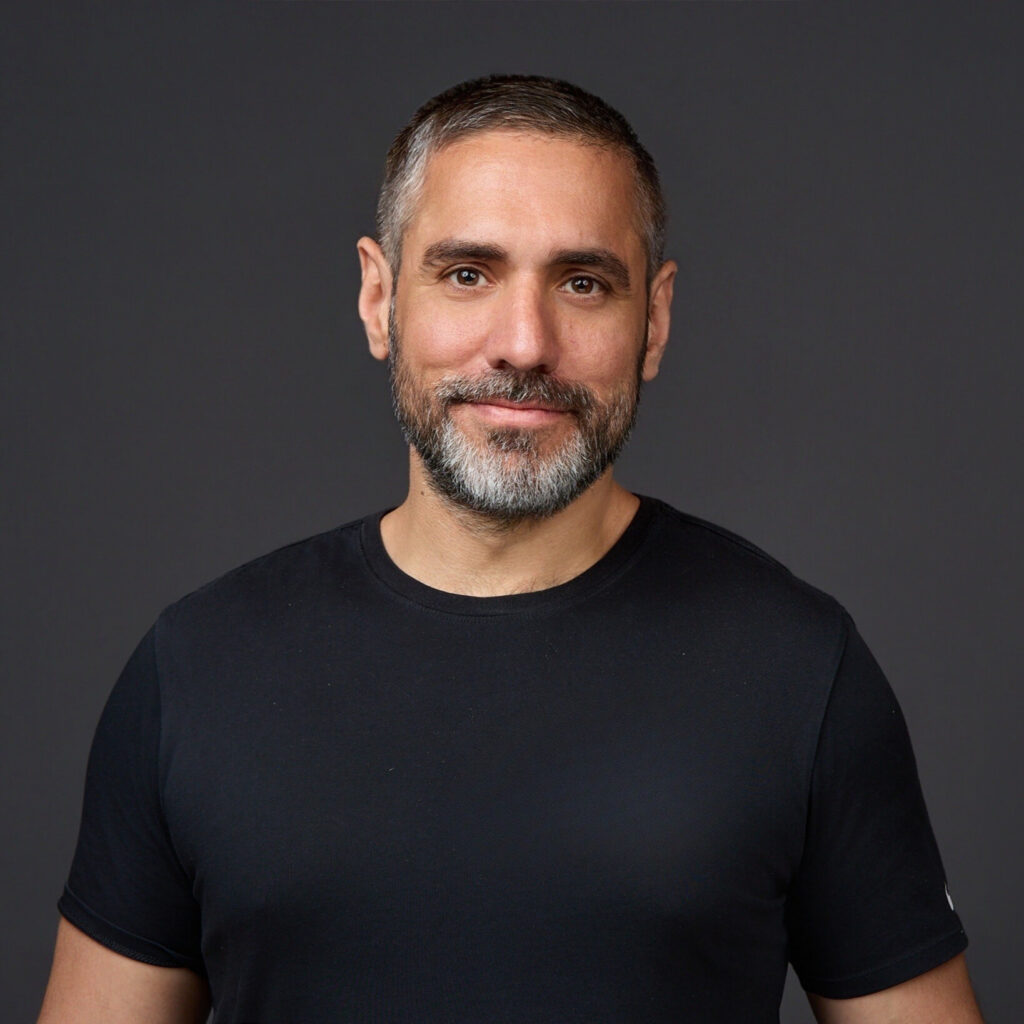
Brandon Daniels has long felt a pull toward complex problem solving of a particular kind.
Technology comes easily to him. He sees not only how databases, machine learning, statistical probability and systems architectures work, but also how to use those modalities to achieve practical results — like ensuring medical supplies requiring parts from all over the world get to the right people on time.
“When something seems tangled, difficult or almost impossible to manage, I tend to be the person who can help unravel it, make sense of it, and solve it in a practical way,” he said. “My career has really been a continuous series of problem-solving opportunities.”
Today, Daniels is CEO of Exiger, a company focused on helping federal defense agencies solve supply chain challenges with artificial intelligence-powered solutions that must meet rigorous security requirements and align to high-stakes missions. Exiger partners with more than 60 federal agencies, plus 150 Fortune 500 companies.
Daniels’ career choices are a callback to his family history. His paternal grandfather was a gunner in the Navy, serving in World War II and fighting on the beaches of Normandy and in Okinawa. His maternal grandfather was a refugee who came to the United States and Great Britain during the Indian partition when he found he no longer had a safe home in India or Pakistan.
“Because of that, I deeply believe in the freedom, liberty and opportunity that the United States, the U.K., the West and free and open democracies represent,” he said.
That posture bleeds over into how Exiger builds its AI — focusing on creating open, transparent markets that serve everyone and resists domination or abuse of power. But he also sees supply chain as relevant to national strength, noting that “supply chain is a new domain of warfare.”
The Ultimatum That Changed Things
By 2008, Daniels had quickly climbed the career ladder, becoming a subject matter expert in forensic, legal and corporate investigations relying on electronically-stored information. But the financial collapse of 2008, combined with his company’s struggles at the time to reach meaningful scale, resulted in a round of downsizing.
“I was essentially given an ultimatum — either do something with the business we had invested in, or our small team would be cut, too,” Daniels recalled.
He and one other person on his team decided to drive the business in a new direction that focused on people, process, automation, machine learning and technology that could increase the scale and speed of workflows for legal, intellectual property and patents.
The result was a year in which the business grew by almost $17 million, he said.
Transformation and Arriving at Exiger
Following more M&A activity, Daniels moved into a new phase of his career, this time helping transform a legal technology business called Clutch into a compliance and legal technology business focused on helping large financial institutions grapple with post-financial-collapse investigations, legal matters and compliance monitoring.
That journey eventually led him to his current role where he already knew many people from his time in the industry. Believing he could learn tremendously from industry colleagues Mike Cherkasky and Michael Beber — who were previously competitors in the industry — Daniels came to Exiger.
He already knew the playbook — turning an inherently services-led business into a technology business. Daniels was brought on to help build, lead and grow Exiger’s technology business. The company was in the midst of an HSBC monitorship, the largest global monitorship in history.
“We had hundreds of people working around the clock across the globe helping HSBC modernize, scale and enforce its sanctions, AML and trade compliance practices,” Daniels said.
The experience revealed that the HSBC monitorship had nothing to do with lack of expertise, he said. Instead, it was about an inability to make sense of the sheer volume of data necessary for sound decision-making.
“That was the real turning point for Exiger,” Daniels added. “I saw how adversaries, unsophisticated companies, market dependencies, and chokepoints were creating major risks for corporations that were going unmanaged and unmitigated.”
‘An AI Evangelist By Design’
Daniels considers himself “an AI evangelist by design,” while Exiger was an AI company by birth. The company’s focus today is three-fold, he said. The first focus is ensuring the entire product development lifecycle is AI-native — a necessity for providing customers with the best software layer for managing supply chain and procurement.
Many companies are struggling with build-versus-buy decisions in supply chain and procurement software and are unsure how to implement AI effectively, he said. With Exiger’s focus on ensuring the product development cycle is AI-native plus companies’ struggle to implement AI in ways that help them gain margin and efficiency, Exiger’s opportunity is clear.
“If we have the best AI-native product development lifecycle, if we can speak with a customer on a Thursday night and implement what they need on Friday, then we can help customers solve problems they cannot solve on their own,” he said.
Exiger’s second priority is “proving to the world that multi-tier supply chain management is possible and valuable,” he said.
Exiger has already worked with Customs and Border Protection, the United States Army, and other major defense programs. Their work in each area has shown visibility into multi-tier supply chains is possible and brings value.
The third priority is helping customers better understand the trade landscape. There has been significant movement in tariffs, export controls and trade enforcement, and part of Exiger’s value is bringing clarity to how companies manage trade compliance, he said.
In this landscape, trade compliance is a strategic imperative for sustainable growth and being seen as aligning around the administration’s AI exports priorities and competitiveness, he said.
“Our growth opportunities are almost limitless right now because of the AI-native product development lifecycle we are building,” Daniels said.
Extreme-Scale Due Diligence
Exiger opted to focus its technology business on extreme-scale due diligence for parties to transactions, trade finance counterparties, companies sending money to one another, supply chain participants, shippers, LLCs, distributors, vendors and counterparties across the globe.
“To manage a global network, you need to understand who you are doing business with,” he explained. “You need to understand that across your supply chain, your shippers, your counterparties, your finance corporations, and the entities set up to facilitate transactions. You need to understand the true nature of those relationships in order to assess risk appropriately and reduce false positives in a sustainable way.”
That belief gave birth to Exiger’s current AI capabilities, such as 1ExigerAI, which functions as a kind of X-ray on any company, site, product or transaction to which it is applied. And not just with one-by-one analysis. 1ExigerAI operates at scale, helping users realize time and cost efficiencies. That ability to scale gives organizations opportunities in spades, he said.
“We built that business in conjunction with the Department of Defense, which was struggling to get visibility into its supply chains, and with financial institutions and major corporations that were rethinking how they managed suppliers, distributors and vendor risk,” Daniels added.
But then, COVID-19 hit. National security and defense decision-makers asked Exiger to join the Joint Acquisition Task Force that included multiple federal agencies. Their mission focused on understanding supply chains at the granular level to speed distribution to frontline hospitals.
“It was an incredible effort,” Daniels said. “We were a data feed, a set of hands, and a set of experts who could help perform supply chain due diligence at scale and identify companies the government could work with in novel ways.”
They became part of Operation Warp Speed, the public-private partnership designed to quickly bring in vaccines and treatments to respond to the pandemic. With insight into where parts, materials and supplies were coming from, Exiger’s work expanded to other government missions and across commercial customers.
Now, Exiger’s focus has narrowed to concentrate on large-scale, complex supply chains across defense, healthcare, advanced manufacturing, information technology and microelectronics.
“Today, Exiger is not just helping organizations diligence and secure their supply chains,” Daniels said. “We are helping them reduce cost, increase speed, increase resilience and move faster than anyone else. We are helping them act first.”
As software and supply chain parts grew rapidly, Daniels was named CEO in the spring of 2022. Exiger then sold the financial services consulting, forensic investigations and monitorship businesses.
The areas where he sees the company being most impactful are in defense sustainment and readiness, especially for the Army, Navy, Air Force and Space Force. And there’s one area where opportunity is especially ripe: helping customers compare demand planning with supply planning, capacity and industrial base constraints. Partners like Palantir already provide insight into demand planning and operational software. The next layer is connecting that information to the other aspects, he said.
Looking ahead, Exiger is focused on hiring top experts and senior advisors, integrating customers’ systems of record, and bringing Exiger’s capabilities to life inside their SAP environment or through partners.
“Our goal is to make our agentic framework, APIs, and deeply trained models available inside the systems our customers already use,” he said. “We want customers to be able to take advantage of our data, our models and our domain expertise inside their own environment, with their own data, while owning their own expertise.”