

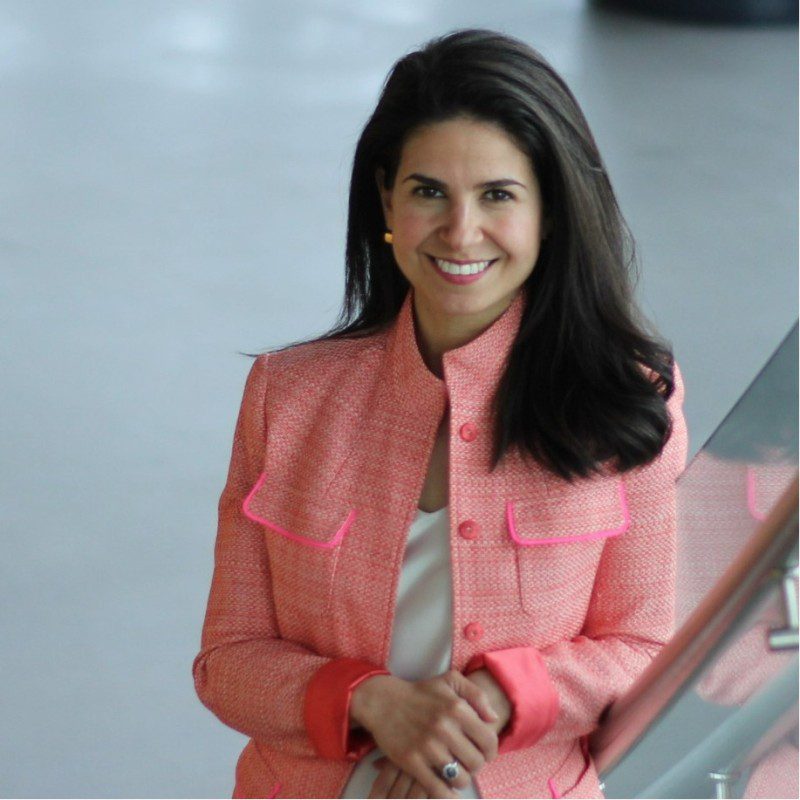
People might assume Karina Lipsman’s career followed a carefully mapped out plan. It did not.
Long before she became a national security professional, public policy advocate, and congressional candidate, Lipsman was a teenager working at a bagel shop. By her senior year of high school, she was already working as a loan officer. She later earned her real estate license, sold land and moved through a range of roles that do not obviously point toward a future in defense and policy.
But together, they tell a clearer story.
“Those early experiences taught me discipline, resilience and how to take initiative,” Lipsman said. “I did not wait for the perfect opportunity. I learned to move forward and figure things out along the way.”
That instinct to step into roles before feeling fully ready has remained a constant.
Today, Lipsman serves as head of external and government relations at the Victims of Communism Memorial Foundation. Prior to that, she held roles at major government contracting firms including Northrop Grumman and Peraton, building a career that spans national security, corporate strategy and public policy.
A Career That Did Not Follow a Straight Line
Lipsman began her career in finance, building experience she later applied in public policy and national security roles. Over time, she found herself drawn toward work where she could have a broader impact.
At Northrop Grumman, she moved into defense and national security, eventually serving as a senior strategist. Her work spanned logistics, international operations, innovation and enterprise strategy, giving her a wide view of how large, mission-driven organizations operate.
One effort brought together engineering teams, vendors, launch providers and academic partners to develop and validate a satellite concept. The project ultimately scaled into a billion-dollar business.
She later joined Peraton during a period of transformation, helping shape corporate strategy and growth across cyber, space, intelligence and defense.
“It was a time focused on integrating capabilities and setting a clear direction for growth,” she said. “That experience strengthened my ability to connect complex technology and policy considerations with business priorities.”
Rather than staying in one track, Lipsman built experience across technology, international affairs and public engagement. She also focused on building relationships beyond her immediate circles.
“Bringing people and ideas together is often what enables progress,” she said. “The challenges that matter most are complex. They require judgment and the ability to move ideas forward even when the path is not straightforward.”
A Campaign That Tested Everything
In 2022, Lipsman ran for Congress in Virginia’s 8th District, a decision that pushed her into a highly visible role where every message, decision and interaction carried weight.
She said the campaign required her to build an operation from the ground up, earn trust quickly and communicate policy positions in a way that resonated with voters across the district.
The experience drew on skills she had developed throughout her career. Adapting quickly, operating without a fixed playbook and making decisions in real time became daily requirements.
“Running for office also gave me a different perspective on public policy, one shaped not just by strategy and analysis but by direct engagement with constituents and the realities they face,” she said.
Personal History, Professional Focus
Born in Odesa, Ukraine, under Soviet rule, Lipsman came to the United States as a refugee.
“I have experienced firsthand the contrast between systems that restrict freedom and those that create opportunity,” she said.
At the Victims of Communism Memorial Foundation, she said she is focused on ensuring that the history and ongoing impact of authoritarian systems remain part of current policy discussions.
Her role includes leading government engagement, shaping legislative strategy, and building relationships with policymakers across party lines. She established a bipartisan Congressional Caucus and has worked to advance legislation such as the Crucial Communism Teaching Act.
In addition to her work at the federal level, Lipsman helped advance policy initiatives at the state level, working with lawmakers to move legislation from concept through passage. That work has involved building coalitions, navigating competing priorities, and sustaining momentum through the legislative process.
“A central part of my work is ensuring research is not just produced, but used,” she said. “It has to inform decisions.”
Turning Insight Into Action
Lipsman’s work sits at the intersection of policy, industry and national security. A key focus is helping close the gap between innovation and implementation.
Technological capabilities continue to advance, but adoption often lags behind. At the same time, issues such as supply chains, data security and foreign influence are increasingly interconnected.
“These are not isolated challenges,” she said. “They cut across national security, economic stability and global competition.”
Her role involves translating complex issues into clear context for decision-makers while also engaging with industry on strategy and positioning.
“The goal is to ensure that analysis leads to action,” she said.
Building Relationships With Purpose
Lipsman said a common thread across her career is her willingness to move forward without having every step defined in advance. She also co-founded Social Capital, a platform designed to help professionals build and maintain relationships more intentionally.
“Your network is one of your most valuable assets,” she said. “But most people manage it by accident.”
In addition to her professional responsibilities, Lipsman serves on the Office of New Americans Advisory Board and the Virginia Conservative Women’s Coalition. She is a council member of the Johns Hopkins University Alumni Association Council and a visiting fellow at both the National Security Institute at George Mason University and the Independent Women’s Forum.
In addition, she co-founded the Alliance of Congressional STEM Fellowships. She is a frequent commentator in national media on issues related to national security and public policy.
She holds a master of science in engineering from Johns Hopkins University and a bachelor of science in economics from Towson University.
“I have never had a perfect playbook,” she said. “But you do not need one to keep moving forward.”